
National Portrait Gallery, NPG.67.2 · CC0 · source
Maryland Patriot · Signer · Justice
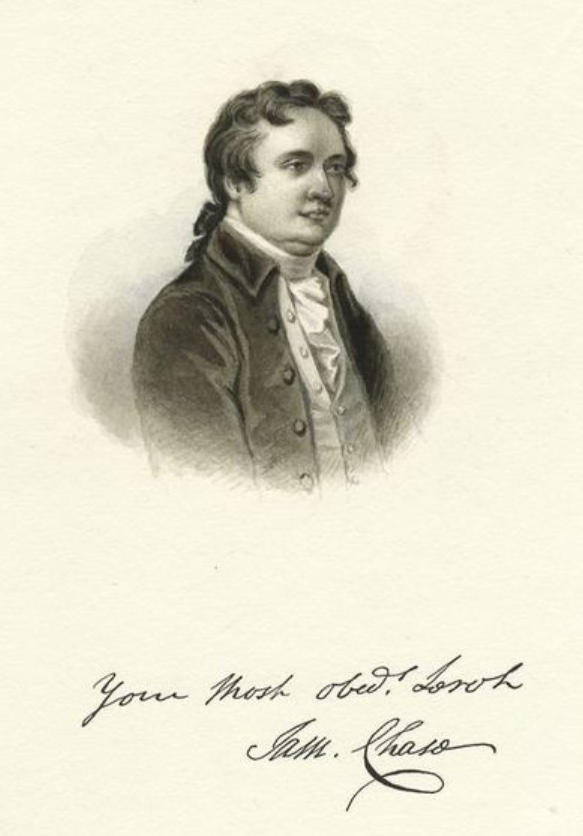
Samuel Chase
1741 — 1811
The Torch That Lit the Revolutionary Flame in Maryland.
1741–1811. Maryland patriot, lawyer, signer of the Declaration of Independence, and Associate Justice of the United States Supreme Court.
By Tom Proctor
A Life in Years
Timeline · 1741–1811
1741
Born near Princess Anne, Maryland.
1761
Admitted to the Maryland bar at twenty.
1765
Leads Annapolis resistance to the Stamp Act.
1773
Co-founds Maryland’s Sons of Liberty with William Paca.
1774
Sits in the First Continental Congress.
1776
Diplomatic mission to Canada with Franklin and Carroll; signs the Declaration.
1788
Anti-Federalist at Maryland’s ratifying convention.
1796
Appointed to the United States Supreme Court.
1798
Writes the opinion in Calder v. Bull.
1804–05
Impeached by the House; acquitted by the Senate.
1811
Dies in Baltimore at age seventy.
I
The Man Before the Monument
Samuel Chase was the sort of man who rarely entered an argument quietly and almost never left one convinced he had lost. He stood well over six feet and carried some two hundred forty pounds, with a complexion so florid that his fellow lawyers christened him “Old Bacon Face.” The name stuck for the rest of his life, which says something about both his face and his friends. He could fill a room before he had said a word, and once he started talking he generally filled it a good while longer. Admirers reaching for something grander called him the Demosthenes of Maryland. His enemies, of whom he gathered a great many, reached for other words entirely.
Beneath the bluster lived a first-rate legal mind, a wicked sense of humor, and a stubborn loyalty to the people and causes he chose. He defended poor men for little or nothing, and he chased a social standing he could never quite afford. He was vain, combative, and often his own worst advocate. He was also brave, brilliant, and incapable of faking a moderation he did not feel. Joseph Story, who knew him in old age, found him coarse on the surface and possessed of “real tenderness of heart” beneath it. Benjamin Rush, rather less charmed, judged that he had “more learning than knowledge, and more of both than judgment.” Both men were describing the same person, which is the difficulty with describing Samuel Chase at all.
.jpg)
NYPL Digital Collections · Public domain · source
II
A Clergyman’s Son
His arrival cost him his mother. Matilda Walker died bringing him into the world near Princess Anne in the spring of 1741, and the Reverend Thomas Chase raised the boy alone on Maryland’s Eastern Shore. Thomas had studied medicine before he took holy orders, and he eventually carried his small household to Baltimore and the parish of St. Paul’s. He gave his son the education of an English gentleman, heavy on the classics, Greek, and Latin, which Samuel absorbed and never entirely stopped quoting.
At eighteen the young man went to Annapolis to read law under two able attorneys, John Hall and Matthias Hammond. Hammond happened to be among the first Marylanders to bristle openly at British rule, and the lesson took root in his apprentice. Chase entered the bar in 1761 and hung out his own shingle. Within a few years he had built a thriving practice and a reputation for taking the cases of ordinary people, the “middling sort” who would become his political base. He was, even then, a man far more comfortable on the attack than at rest.

Engraving after John Moale · Public domain · source
III
A Young Firebrand
%20and%20her%20daughters%20Anne%20and%20Matilda%20Chase.jpg)
Charles Willson Peale · Public domain · source
In May 1762 Chase married Anne Baldwin, a match made for affection rather than advantage, since the bride brought him neither fortune nor rank. They would have seven children, of whom only four survived to grow up. That same year an Annapolis debating society expelled him for conduct it called “extremely irregular and indecent,” an early sign that the rowdiness would outlast his youth. He also struck up a friendship with the lawyer William Paca that would carry both men all the way to the Declaration of Independence. In 1764 the voters of Anne Arundel County sent him to the assembly, where he would sit for the next twenty years.
a busy, restless incendiary, a ringleader of mobs
Then came the Stamp Act, and Chase found his calling. He threw himself against the tax before most of his cautious colony dared, leading a band of young men who seized stamps and burned the distributors in effigy. The colony’s more careful gentlemen were appalled. When Annapolis loyalists denounced him in print as “a busy, restless incendiary, a ringleader of mobs,” Chase did not so much defend himself as counterattack, accusing them of ruling by “proprietary influence, court favour, and the wealth” that infested the city. He made enemies in that quarrel who would nurse the grudge for decades. He did not appear to mind.
When the Stamp Act fell and new taxes rose to replace it, Chase moved past mere protest to the idea his colleagues least wanted to hear, which was independence. He helped found the Anne Arundel Sons of Liberty with Paca and lent his considerable lungs to Maryland’s Committee of Correspondence. Admirers took to calling him “the Samuel Adams of Maryland,” and for once the comparison was apt.
IV
The Road to Independence

After Robert Edward Pine · Public domain.
,_by_John_Trumbull.jpg)
U.S. Capitol Rotunda · Public domain · source
By 1774 Chase had made up his mind, which for him was less a decision than a force of nature. Maryland sent the thirty-three-year-old to the First Continental Congress that September, where he argued for separation earlier and more loudly than nearly anyone in the room. In the Second Congress he set about dragging his hesitant colony over the line it had no wish to cross.
Early in 1776 Congress handed him a thankless errand far from home, packing him off to Canada with Benjamin Franklin and Charles Carroll of Carrollton to coax Quebec into the rebellion. The commissioners reached Montreal, lodged at the Château Ramezay, and discovered that the American military effort was already coming apart at the seams. Franklin, old and ailing, gave it up and turned south in May. Chase and Carroll lingered a few more weeks until the collapse chased them out. The mission failed completely, and it left Chase more certain of independence than ever.
He came home and went to work. While Congress argued in Philadelphia, he rode across Maryland rounding up support, and his efforts helped free his colony’s delegates to vote for the break at last. When the moment came he signed the Declaration of Independence, the first of Maryland’s four signers and the thirty-sixth name on the page. For a man who had spent a decade demanding precisely this, it was a satisfaction long in coming.
Where He Worked & Walked
Six places that shaped a revolutionary life. Inspired by colonial cartography from the David Rumsey Map Collection.
Princess Anne, Maryland
Born 1741 on the Eastern Shore to Rev. Thomas Chase and Matilda Walker.
Annapolis
Read law, joined the bar in 1761, served twenty years in the colonial assembly.
Baltimore
Settled here in 1786; sat as chief judge of the criminal court; buried at Old St. Paul’s.
Philadelphia
First and Second Continental Congresses; signed the Declaration of Independence, 1776.
Montreal
1776 diplomatic mission with Franklin and Carroll; lodged at the Château Ramezay.
Washington, D.C.
Served as Associate Justice of the U.S. Supreme Court, 1796–1811.
V
Judge and Justice

Digital Commonwealth · Public domain · source

HABS, Library of Congress · No known restrictions · source

Library of Congress · Public domain · Wikimedia Commons
Glory did not pay Chase’s bills, and in 1778 his career nearly ended in scandal. Rivals accused him of using what he had learned in Congress to corner the flour market, and the charge cost him his seat. He retreated to the law, moved to Baltimore in 1786, and rebuilt himself on the bench, first as chief judge of the Baltimore criminal court and then of the Maryland General Court.
His arrival at the Supreme Court came by an unlikely road. The Court in 1796 was nobody’s idea of a prize, ill-paid and burdened with brutal circuit-riding, and capable lawyers tended to decline the honor. But Washington admired Chase’s legal gifts and remembered his Revolutionary zeal, and James McHenry, a Maryland friend of the president, spent more than seven months lobbying on his behalf. When the offer finally came, McHenry reported that he had “made an old veteran very proud and happy.” Washington named Chase on January 26, 1796, to fill John Blair’s seat, the Senate confirmed him the next day, and he took his oath on February 4.
He joined a small and very young institution. The Court held only six seats, and Chase became its ninth member, with just eight men ahead of him in its short history, all of them Washington’s choices. John Jay had led it as the first Chief Justice, while James Wilson, William Cushing, John Blair, and John Rutledge had sat early, and James Iredell, Thomas Johnson, and William Paterson rounded out the bench. Blair’s resignation had opened the very chair that Chase now filled.
The choice annoyed a good many Federalists, who had not forgotten his past. Chase had fought their Constitution at Maryland’s ratifying convention in 1788, had tried to keep his state from approving it, and had skipped the Constitutional Convention altogether the year before. Yet age and office had cooled his fear of central power, and on the bench he turned into one of the most ferocious Federalists of the age, the sort of conversion that tends to embarrass everyone involved.
Every ex post facto law must necessarily be retrospective; but every retrospective law is not an ex post facto law.
His opinions outlasted his temper. In Ware v. Hylton he held a national treaty superior to conflicting state law, an early and important assertion of federal authority. In Hylton v. United States the Court for the first time measured an act of Congress against the Constitution. And in Calder v. Bull he fixed the meaning of the Ex Post Facto Clause, ruling that it reaches only retroactive criminal laws and not civil ones, while insisting that no legislature held unlimited power over its citizens. “I cannot subscribe to the omnipotence of a State legislature,” he declared from the bench, in a line that still echoes through constitutional argument.
VI
Jefferson’s Target

White House Historical Association · Public domain · Wikimedia Commons
The election of 1800 swept Thomas Jefferson and his Republicans into power, but the courts stayed stubbornly Federalist. John Adams had spent his last weeks in office stocking the bench for life and installing John Marshall as Chief Justice, and Jefferson meant to break that grip. He needed only a pretext, and Chase, never shy, obligingly supplied one.
The justice had run his sedition trials more like a prosecutor than a judge, bullying defendants and their lawyers in the Callender and Fries cases. Then in May 1803 he stood before a Baltimore grand jury and delivered a frank political tirade, warning that the republic would “sink into a mobocracy, the worst of all governments.” Jefferson read the speech and saw his opening. He wrote to a Maryland congressman to ask, with studied innocence, whether Chase’s “seditious and official attack on the principles of our Constitution” should “go unpunished.”
The Republicans had already removed one federal judge, the unfortunate John Pickering of New Hampshire. Chase was a far larger target, the first Supreme Court justice in their sights, and everyone understood the stakes. If Chase fell, Marshall would surely be next, and with him the Court’s young authority, including the power of judicial review that Marshall had just claimed in Marbury. Marshall himself read the charges and found them cause to alarm the friends of an independent judiciary. He was not wrong to worry.
VII
The Trial
The House impeached Chase in 1804 on eight articles, most of them aimed at the sedition trials and the Baltimore harangue. His trial opened in the Senate in February 1805, with Vice President Aaron Burr presiding, an arrangement rich in irony, since Burr was at that moment wanted for killing Alexander Hamilton in a duel. One observer marveled at the spectacle of a judge arraigned before a man who might himself have stood arraigned for murder.
The prosecution, led by the erratic John Randolph, proved no match for the occasion. Chase’s defenders, with the formidable Luther Martin at their head, took the charges apart one by one, arguing that not a single article described an actual crime, and that no judge could be removed for his opinions or his temper. The argument carried.
The Senate acquitted Chase on every count on March 1, 1805. The Republicans held more than the two-thirds they needed to convict him, and they declined to use it. Enough of them refused to remove a judge over his rulings and his politics, however much they disliked both, and however little they cared for the man. It was, in the end, a vote against their own short-term advantage, which is the rarest kind there is.

John Vanderlyn · Public domain · Wikimedia Commons
.gif)
U.S. Senate Historical Office · Public domain · Wikimedia Commons
VIII
Twilight

HABS, Library of Congress · No known restrictions · source
The acquittal saved Chase’s seat but not his spirits. He returned to the bench a diminished figure, ill, deep in debt despite his thousands of acres, and weighed down by the disgrace of having been tried at all. Arthritis and gout crippled him, and by 1807 he was missing sessions of the Court. He died of a failing heart on June 19, 1811, at the age of seventy, and they buried him at Old Saint Paul’s in Baltimore, the parish his father had once served. He left behind less money than land, and more reputation than either.
IX
His Lasting Legacy
Chase signed the Declaration, and it would be easy to let the signature stand as his monument. It would also be wrong. His deepest mark on the country came not from the parchment but from the bench, and not from his triumphs but from his near-destruction.
His acquittal settled a question the young republic badly needed answered. A judge could not be hauled from office for unpopular rulings or partisan leanings, but only for genuine crimes. Chief Justice Rehnquist, looking back nearly two centuries later, called this the governing rule ever since, and so it has proved. Every impeachment of a federal judge since Chase has charged real misconduct rather than mere disagreement with how he judged.
The irony is almost too neat to credit. The most nakedly partisan justice of his generation became, against his own will, the guardian of judicial independence. By sparing the difficult, blustering Chase, the Senate spared John Marshall and the Court’s new authority, and the power of judicial review survived its first serious assault intact. Chase’s own opinions did the quieter work of building the law, establishing treaty supremacy, the review of federal statutes, and the principle that legislatures answer to limits. Later courts would fold that idea of limits into the Constitution’s guarantees of due process.
Taken together, these things outlast the name on the Declaration. He helped draw the boundary between politics and the courts, and the boundary held. It holds still. The torch he carried in Maryland, lit in anger and tended in stubbornness, never quite went out.
Public domain · Wikimedia Commons
Lineage
Family Band
Parents
Rev. Thomas Chase
Matilda Walker
Wives
Anne Baldwin (m. 1762)
Hannah Kitty Giles (m. 1784)
Surviving Children
Anne · Matilda · Samuel · Thomas
Proctor connection: documented through Eastern Shore Maryland lines — see citation fields below.
- Find a Grave: Memorial #2804
- DAR: Ancestor #A021208
- FamilySearch: profile search
Circle
Related People
William Paca
Closest friend; fellow Maryland Signer.
Charles Carroll of Carrollton
Co-commissioner on the 1776 Canadian mission.
Thomas Stone
Maryland Signer alongside Chase.
Benjamin Franklin
Led the Canadian mission with Chase in 1776.
Aaron Burr
Vice President; presided over Chase’s 1805 impeachment trial.