The English Proctors crossed the Atlantic during the Great Migration of 1620 to 1640. Between 13,000 and 21,000 English people left for New England in those two decades. They were nothing like the Jamestown adventurers who'd come a generation earlier in the 1600s. They came in family groups, often led by ministers, and brought account books and Bibles. Nearly half came from East Anglia, with substantial numbers from Lincolnshire and Yorkshire. Almost every English county sent at least one family across the ocean that decade. The cause was political and religious, not economic, in the great majority of cases. King Charles I had a Catholic wife and a Catholic taste in liturgical practice. His Archbishop, William Laud, was rooting nonconformity out of the Church of England. The Puritans saw which way the wind blew and chose to leave for America.
The 1635 Crossing
The Proctors who matter most to American history left in April of 1635. Their ship was the Susan and Ellen, sailing from London to Massachusetts Bay Colony. John Proctor Sr., his wife Martha Harper, and their three-year-old son also named John, sailed. They settled at Ipswich, on the Chebacco coast a few miles inland from the Atlantic. John Sr. became a yeoman farmer of substance in the new colony of Massachusetts Bay. He held shares in Plum Island, served in colonial offices, and accumulated land steadily. He was a man who'd done the careful Puritan work of building a competence. It was the standard pattern of the Great Migration generation across New England towns.
His son John grew into the most famous Proctor in American history by accident. By 1666 the younger John was 35 and had moved south to Salem. He leased a 700-acre farm in what's now Peabody, Massachusetts, called Groton Farm. The property was sometimes called Downing Farm after the landlord's family in London. Proctor leased it from Emanuel Downing, brother-in-law of Governor John Winthrop himself. By 1668 he had a license to run a tavern on the Ipswich Road. He married three times and had eighteen children across the three marriages by 1690. By 1692 he was a prosperous farmer of 60 with a third wife and a houseful. His third wife was Elizabeth Bassett, who would also face the witch trial accusers.
The Trials Begin
That February the Salem witch trials began in the household of Reverend Samuel Parris. His daughter Betty and niece Abigail Williams started having fits in early February 1692. Within months the panic had spread across the village and into the larger town. Tituba, an enslaved woman in the Parris household, was the first one accused. Then came Sarah Good, then Sarah Osborne, then Rebecca Nurse and dozens more. The accusations came from a small group of teenage girls and young women. Their testimony was treated as legal evidence in the court of Oyer and Terminer. The court accepted what was called spectral evidence to establish a defendant's guilt. That meant the claim that the accused had appeared in spirit form to torment witnesses.

Proctor Speaks Out
John Proctor said plainly what other men in the village were afraid to say aloud. He called the afflicted girls frauds and the trials themselves a public sham. He said the proceedings should be stopped before they killed anyone else in Salem. He defended his wife Elizabeth when the accusations turned toward her household. Then the accusations turned to him as well, on the testimony of his former servant. Mary Warren said that he had beaten her for putting up a prayer bill. Then she said he'd forced her to touch the Devil's Book to recruit her. Thirty-two of his neighbors signed a petition in his favor with the court. They said he had lived a Christian life and stood ready to help others always. The court convicted him and his wife anyway and sentenced them both to die.
While he sat in jail awaiting execution, the sheriff seized his entire estate. The cattle were sold cheap, slaughtered, or shipped off to the West Indies markets. The beer barrels in the tavern were emptied or sold to the next innkeeper. His children were left destitute and without means of supporting themselves on the property.
Gallows Hill
John Proctor was hanged on August 19, 1692, at Proctor's Ledge on Gallows Hill. He died alongside Reverend George Burroughs, Martha Carrier, George Jacobs, and John Willard. Elizabeth Proctor was spared because she was pregnant at the time of the trial. Their unborn son, also named John, was born in jail in January 1693 afterward. He was born after the panic had finally broken and the trials had stopped. John Proctor was the first man, as opposed to woman, condemned in the witch trials. By the time it was all over twenty people had been killed at Salem. Roughly two hundred had been accused in the village and the surrounding Essex County towns.
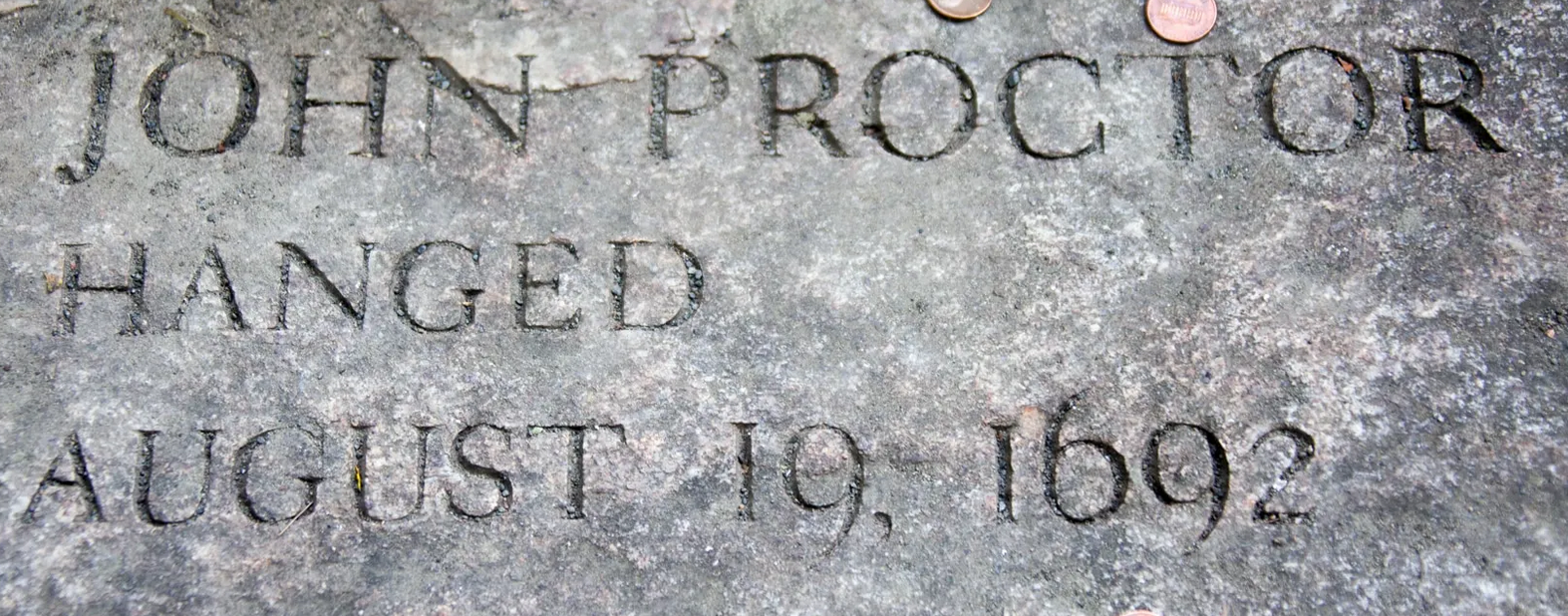
Visit Proctor's Ledge Memorial — Salem Witch Museum
The Long Reversal
The legal reversal began slowly, as such reversals tend to do in colonial America. In 1711 the Massachusetts legislature passed an act of attainder reversal for many victims. They paid £150 to the Proctor family in restitution for John's death and imprisonment. In 1957 the state issued a partial proclamation of innocence covering only Ann Pudeator. The final exoneration of all the victims wasn't signed until October 31, 2001. Governor Jane Swift signed the bill three hundred and nine years after the hangings. The Proctor family had been waiting on that signature for those entire three centuries.
The Crucible and the Stage
In 1953 Arthur Miller put John Proctor on the American stage in The Crucible. Miller wrote the play in response to Senator McCarthy's communist hearings in Washington. He needed an American everyman who would refuse to lie to save his own life. Proctor became that man for generations of American high school students and theater audiences. Yves Montand played him in the 1957 French film adaptation of the play. Daniel Day-Lewis played him in the 1996 American film version directed by Nicholas Hytner.
The historical Proctor was rougher around the edges than Miller's version on stage. He was older, less romantically tormented by his servant Abigail, and harder in his manner. His marriage was less the hot center of the play in the historical record. But Miller got the essential thing right about the man who carried the name. Proctor refused to confess to a thing he hadn't done, and he was hanged for that. The name survived the gallows and crossed three centuries to October of 2001 finally.
After Salem
Eight generations of Proctors lived on the old Downing Farm in Peabody until 1851. The John Proctor House still stands at 348 Lowell Street in Peabody, Massachusetts. The house was built around 1727 by Proctor's son Thorndike, not by the man himself. The earlier house on the same spot had burned down before the 18th century opened. The Proctor name in America branched out from Salem to every corner of the country. Some Americans carried it consciously, with the trial somewhere in family memory at home. Many didn't know the connection at all and lived their lives without the burden.